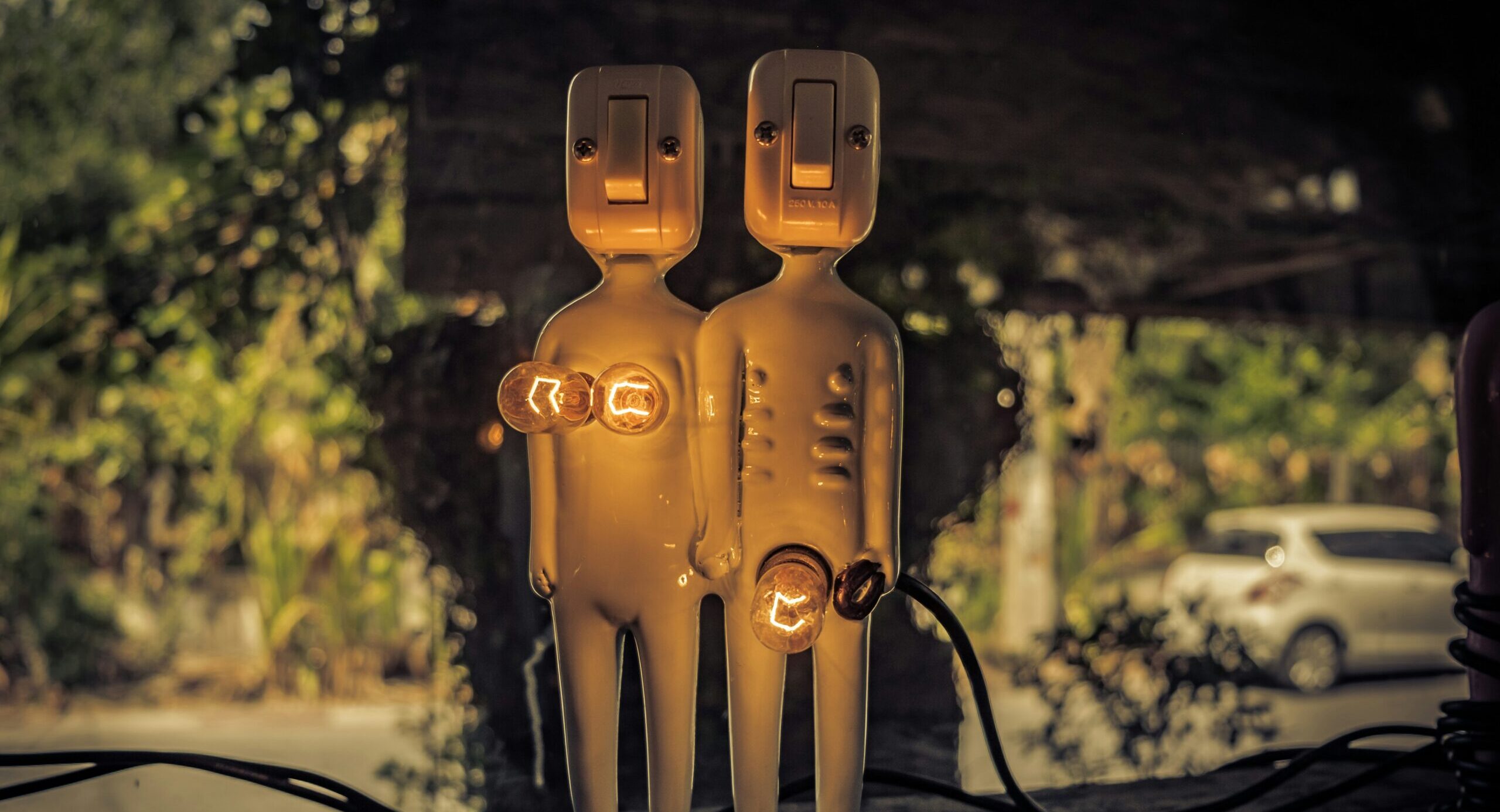
Do Androids Dream of Electric Sheep? Asks the title of Philip K. Dick’s most well-known novel, which famously inspired Blade Runner—a cult classic I never got into. I know, I know, everyone is raving about this movie, it’s so amazing, cool, revolutionary, and all that. A timeless classic. A masterpiece. Yet, as I repeat these words after thousands of reviewers, I just don’t feel it, personally. Zero feelings whatsoever. Nada.
The book, though? I loved it. But let’s just say that it’s almost a whole different story—the movie covered some of its concepts and twisted them into a different direction. So, my feelings, or the lack of them, make complete sense.
But I’m not attempting to write a review of either here. I don’t want to spoil the fun of discovering both on your own. I will, however, discuss the book’s main questions and Dick’s thoughts about humanity, authenticity, and reality.
A Post-War Backdrop
Philip K. Dick wrote Do Androids Dream of Electric Sheep? (‘Androids’) in 1968, during the peak Cold War era, when peace seemed fragile, when past enemies became eager collaborators, and old allies posed a new threat. In this era of technological advancements, propaganda, and extreme espionage, one would have trouble understanding what’s real and what’s an illusion. Dick channeled this volatile atmosphere into his work: we meet our protagonist in a post-war setting, where human colonies live on Mars, and some of their escaped android ‘slaves’ infiltrate the humans remaining on Earth. And they need to be eliminated.
What Makes Us Human?
The book revolves around this question and the feeling of empathy; a lack of which would indicate that someone is less than human. Androids, however, are human-like to the degree that an untrained eye wouldn’t be able to distinguish the difference, and an empathy test needs to be performed on them to determine their true nature and eventually “retire” (kill) them.
But what is it, really, that makes us human? Is that it? Empathy? And now that we are at it: what is empathy? Is it a skill we can learn and improve with practice?
Is Empathy A Teachable Skill?
Generally speaking, empathy involuntarily occurs when we attempt to put ourselves in others’ shoes. When we listen to them carefully, understand their situation, perspectives, motives, and feelings, a sense of merging might occur—we feel what the other person feels. That is when we are empathising with them. Carol M Davis concludes in her article, “What Is Empathy, and Can Empathy Be Taught?”, that this ability cannot be taught. Still, its spontaneous occurrence can be facilitated by improving certain teachable skills.
It is said that the more similar we are to the other person, the more shared experiences we have, the more likely we are to empathize with them. However, Davis’s article also highlights that “by virtue of the fact that we all breathe, we have the capacity to experience the breathlessness of another person, no matter how different that person appears.”
Apparently, androids can’t learn empathy, and neither can we, humans.

Real vs. Fake – The Lines Are Blurred
Dick has spent decades seeking answers to some of the most difficult questions one can pose, but the answers remained hidden from him. In his essay “How to Build a Universe That Doesn’t Fall Apart Two Days Later” (1978), he discusses his findings in great detail, considering several aspects of reality, pseudo-realities, and authenticity.
He talks about how everyone experiences the world differently, and when these differences become a problem:
“Maybe each human being lives in a unique world, a private world, a world different from those inhabited and experienced by all other humans. And that led me wonder, If reality differs from person to person, can we speak of reality singular, or shouldn’t we really be talking about plural realities? And if there are plural realities, are some more true (more real) than others? What about the world of a schizophrenic? Maybe, it’s as real as our world. Maybe we cannot say that we are in touch with reality and he is not, but should instead say, His reality is so different from ours that he can’t explain his to us, and we can’t explain ours to him. The problem, then, is that if subjective worlds are experienced too differently, there occurs a breakdown of communication… and there is the real illness.”
A One-Sentence Answer
In the essay, Dick shares the story of a college student who reached out to him four years after writing ‘Androids’. She was working on a paper for her philosophy class and asked him to define reality in one sentence.
“I thought about it and finally said, “Reality is that which, when you stop believing in it, doesn’t go away.” That’s all I could come up with. That was back in 1972. Since then I haven’t been able to define reality any more lucidly.”
Pseudo-Realities, The Universes of The Mind
He then elaborates on how the media, governments, big corporations, religious groups, and political groups create pseudo-realities to support their agenda, deliver a message, and keep their audience passive and cooperative.
“(…) I distrust their power. They have a lot of it. And it is an astonishing power: that of creating whole universes, universes of the mind. (…) I consider that the matter of defining what is real — that is a serious topic, even a vital topic. And in there somewhere is the other topic, the definition of the authentic human. Because the bombardment of pseudo-realities begins to produce inauthentic humans very quickly, spurious humans — as fake as the data pressing at them from all sides. My two topics are really one topic; they unite at this point. Fake realities will create fake humans. Or, fake humans will generate fake realities and then sell them to other humans, turning them, eventually, into forgeries of themselves. So we wind up with fake humans inventing fake realities and then peddling them to other fake humans.”
The Power of Words and Creating Fake Realities
Dick compares the potential of pseudo-realities to the Orwellian control through words and the impact of audiovisual content (TV) on viewers.
The basic tool for the manipulation of reality is the manipulation of words. If you can control the meaning of words, you can control the people who must use the words. George Orwell made this clear in his novel 1984. But another way to control the minds of people is to control their perceptions. If you can get them to see the world as you do, they will think as you do. Comprehension follows perception. How do you get them to see the reality you see? After all, it is only one reality out of many. Images are a basic constituent: pictures. This is why the power of TV to influence young minds is so staggeringly vast. Words and pictures are synchronized. The possibility of total control of the viewer exists, especially the young viewer.
What Do Androids Dream Of?
The essay I’m quoting was written 47 years ago, but these perspectives seem timeless as old-school science fiction slowly becomes reality. On our way to becoming “posthuman”, we rely on a multitude of devices, systems, and software to make our lives easier, to make us feel a certain way, and to solve everyday problems. We use social media to connect, to unite, to find our communities. Our realities have become much more complex than they were 10 or even 5 years ago. We are drowning in information and data, and we become desensitized as violence becomes normalized and radical views spread like wildfire. Where will all of this lead us? Can we differentiate between fake and real? Does it matter, and why or why not? And what do androids dream of?
Recommended readings and references:
How to Build a Universe That Doesn’t Fall Apart Two Days Later by Philip K. Dick (1978)
What Is Empathy, and Can Empathy Be Taught? by Carol M Davis (1990)
The Posthuman Vision of Philip K. Dick in Do Androids Dream of Electric Sheep? by Gilbert McInnis (2018)
Defining “Human”: The Blurry Line Between Human, Androids, and Animals In Do Androids Dream Of Electric Sheep? by Sevda Altınoluk (2020)
Read more about books here.
This post may contain sponsored or affiliate links.